
Where Merced Previous Residents Leave Records
One address can have an ownership history, an occupancy history, and a building history. The coverage table keeps those trails separate. It also shows where online access stops and where a counter, shelf, archive, or request form becomes necessary.
| Source | Years or coverage | Where held | What it shows |
|---|---|---|---|
| Recorder official records | RecorderWorks index 1963-present; earlier indexes in office | Recorder web portal, counter, books, and microfilm | Grantor, grantee, document, date, legal description, and ownership chain |
| Merced-Madera directories | 1914, 1917, 1920, 1922, 1926-1931, 1935 | NARA inventory and microfilm | Address, occupant, occupation, and annual snapshot |
| Polk and other city directories | 1877, 1884-1885, 1890, 1914, 1928-1989 selected years | Courthouse Museum, public library, State Library catalogs | Business, household, street, and telephone clues |
| Federal census | Public schedules through 1950 | NARA and partner repositories | Enumerated household on a census date |
| Accela and city permits | Current portal; historical cutoff not published | County Accela or city department | Construction, work, applicant, status, and inspections |
| Sanborn maps | City and year must be verified in the catalog | Library of Congress and local libraries | Structure footprint, use, materials, and street labels |
| Newspaper, obituary, and probate | Merced Sun-Star online 2001-present; older coverage varies | Library, museum, court, and catalog or microfilm | Moves, deaths, heirs, events, and address context |
Start with the era of interest. A current ownership question begins with the Recorder. A 1930 household begins with a directory and census. A building change begins with permits and maps. A family transition may end with an obituary or probate file.
Merced Previous Residents Start With APN
The modern address is a useful label, but the APN and legal description carry the chain more reliably. The Merced Tax Collector's documented Street Address mode can identify the fee parcel, physical-address location, lien-date owner, tax-rate area, and separate mailing block. Enter the parcel in Assessment Inquiry for assessment information, characteristics, exemptions, and map context. Do not merge a situs address with a tax mailing address when you build the timeline.
The current owner is a starting point, not the first person ever connected to the land. Save the parcel, subdivision, lot and block, township and range where present, and every legal-description phrase. A rural Merced property may have no stable street-address trail, while a subdivision can change its address wording without changing the title identity.
For current map and parcel mechanics, use the Merced by-address record chain. Previous residents require the additional work of matching older occupants to the title and place history.
Merced Previous Residents: Deed Trail
RecorderWorks is the verified grantor and grantee index for Merced official records recorded from 1963 forward. Search the current owner as grantee to find the acquisition deed. Record the grantor, recording date, document number, APN, and legal description. Search that grantor earlier as grantee and repeat the process. Each link must be tested against the parcel or legal description, because a name match alone can join unrelated people. The county legal-records search instructions describe the handoff to earlier indexes and office records.
- Normalize the current situs and save the APN, map, subdivision, and legal description.
- Search the owner as grantee in RecorderWorks, then open the indexed document record.
- Copy the seller, date, document number, type, APN, and legal description into the timeline.
- Search the seller as an earlier grantee and verify the same land before moving back again.
- At the 1963 web cutoff, continue through pre-1963 official indexes, books, microfilm, and office kiosks.
- Grantor
- The party transferring an interest in the recorded document.
- Grantee
- The party receiving an interest in that document. A grantee is not automatically an occupant.
- Chain of title
- The linked sequence of recorded transfers that connects later ownership to earlier owners.
- Legal description
- The formal description of the land, such as a lot and block or township reference. It can be more stable than a street label.
The Merced RecorderWorks index is the source shown below.
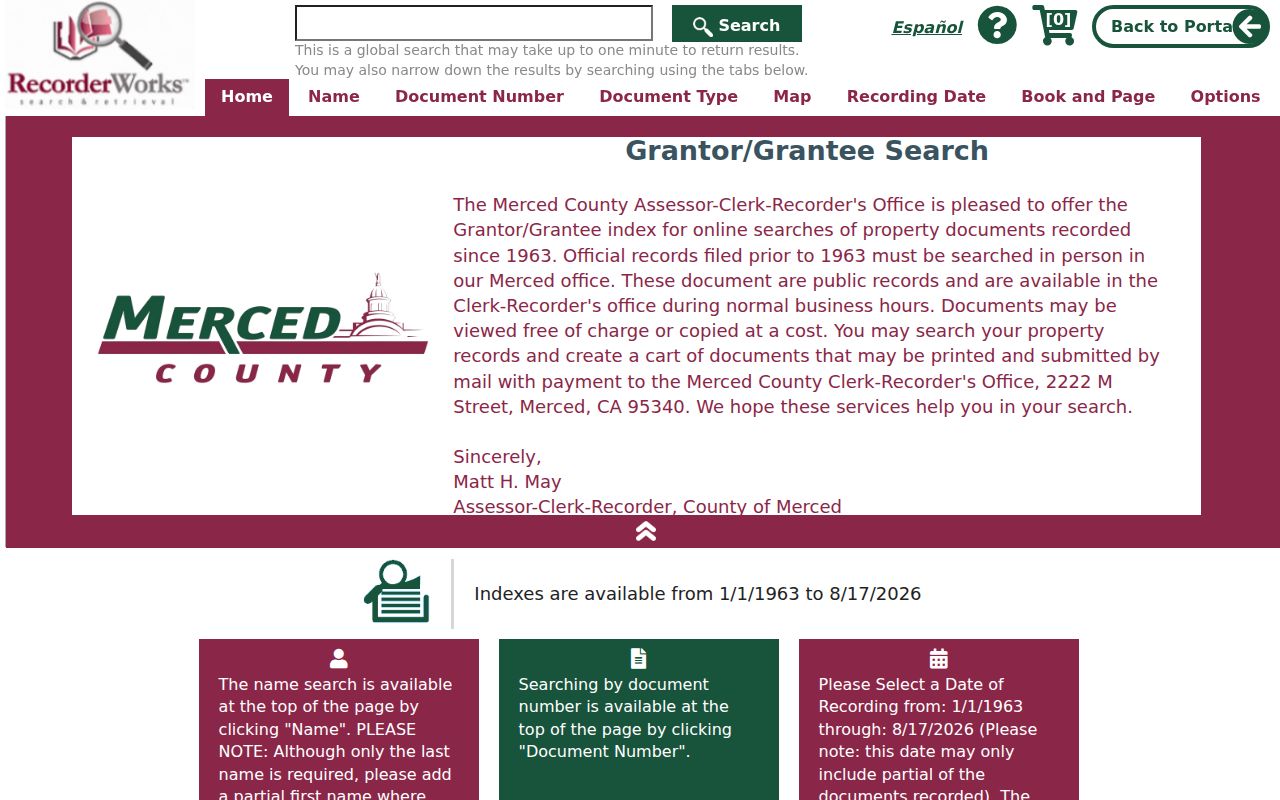
The RecorderWorks image links to the official index used to walk a Merced deed chain. The index is a finding aid, and document images or certified copies follow the Recorder's access and fee rules. Check the county fee schedule before ordering copies.
Merced Address Records Outlast Street Names
Older deeds may use a lot, block, subdivision, township, range, section, metes-and-bounds, ranch, or survey description rather than a street address. A rural route may later become a numbered road. A subdivision or E911 change may alter the house number. Annexation can move service jurisdiction while the title land remains the same. The research did not locate a verified countywide street-renumbering chronology.
Bridge the gap with a dated assessor map, recorded subdivision plat, County Surveyor record, contemporaneous directory street guide, Sanborn sheet, and APN. The Surveyor preserves Corner Records, Government Townships, Miller & Lux Records, unrecorded surveys, and recorded maps. Its search instructions use township and range, with section optional, and expose a Survey Index Maps download.
When a literal street search fails, do not conclude that the parcel or previous residents vanished. Change the key, not the fact: search the legal description, map, APN, lot-block, or township reference.
The Merced Previous Residents Timeline
Directory years supply occupancy snapshots around the deed chain. NARA verifies Merced-Madera volumes in 1914, 1917, 1920, 1922, 1926 through 1931, and 1935. The Courthouse Museum lists business directories for 1877 and 1884-1885, a 1890 Polk gazetteer, Polk's Merced City Directory years including 1914, 1928-1929, 1930-1931, 1935, 1938, 1941, 1963, and 1966, and Merced-Atwater years 1971, 1972, 1980, 1988, and 1989.
These are not a continuous list. A directory is shaped by canvass, subscription, rural coverage, and the publisher's household conventions. A person can disappear because of a move, death, surname change, nonlisting, or a different household entry. Use the street section for the address and the alphabetical section for the person, then note occupation, spouse, address, and abbreviations without silently expanding them.
The Merced city directory collections page covers the repositories and entry mechanics. This previous-residents path uses those collections only as evidence in an address timeline.
Pair Merced Directories With Census Years
The federal census adds a household enumeration to the annual directory snapshot. Pair 1914, 1917, and 1920 directory entries with the 1920 census. Use the 1926 to 1931 run around 1930. The 1935 volume can help interpret the 1940 census question about residence in 1935. NARA's Enumeration District descriptions and maps can help bridge an address to a census page.
- Copy the address and surname from the directory, including spouse, occupation, and nearby streets.
- Find the matching census year and compare household members, ages, birthplace fields, and address or enumeration context.
- Return to the next directory volume and mark the first year with a new address, spouse, or household member.
- Use a deed, newspaper, obituary, or probate file to explain a transfer or disappearance.
Federal population schedules are publicly released through 1950 under the 72-year rule, so the 1950 schedule is the newest public census in 2026. A census date and a directory publication date do not match exactly. Disagreement is a research lead, not automatic error.
Merced Previous-Resident Building History
Sanborn fire-insurance maps can show a structure's footprint, use, materials, outbuildings, and street labels for a mapped city and year. The Library of Congress collection is digitized, but a Merced sheet and year must be verified in the catalog. A map can help answer whether a building existed, how it was arranged, or why a modern address does not match an earlier street sequence.
Use the map with a deed legal description, property map, permit, and directory. A footprint does not identify every occupant, and a map label does not prove the later parcel number. The County Surveyor and Courthouse Museum map collections can add local context, including official county maps that identify property owners.
Construction, additions, demolition, and street-label changes belong in the building timeline. Occupancy still comes from a directory, census, newspaper, or other source that names people at an address.
Merced Past Residents at Stoddard
The Stoddard Room at Merced Main Library is a distinctive local research resource. The county historic-resources report calls it the most useful repository for detailed Merced County sites and buildings and says its material is unavailable elsewhere. Use it for photographs, clippings, local histories, address changes, and building files that can connect a place to a household or event.
The Genealogy Room, Merced County Genealogical Society volunteers, and Courthouse Museum research room provide complementary channels. The museum is at 21st and N Streets, with research access Wednesdays from 10 a.m. to 2 p.m. or by appointment and phone (209) 723-1307. The library's NewsBank access supplies Merced Sun-Star content from 2001 to the present for cardholders with a PIN.
Ask a librarian or archivist for a source by address, owner, prior street name, publication year, and record series. A shelf search is often the fallback when a modern portal has no historical coverage.
Merced Previous Residents: Obituaries
Previous residents often leave their clearest public trail at a life event. A Merced Sun-Star obituary or older newspaper notice can identify relatives, a former address, a move, an organization, or a date of death. A cemetery record is a lead. Confirm relationships and dates against the official death record, burial register, obituary, or probate file.
Probate petitions, notices, estate deeds, and representative filings can connect a decedent to heirs and a parcel. Merced probate records are not in the remote court subset, so use the clerk counter, public terminal, mail request, or records-search form. An estate transfer can explain why the grantor and grantee sequence changes without a normal sale.
For a birth, death, or public-marriage copy, follow California's authorized and informational copy rules. Confidential marriage, adoption, juvenile, sealed, and protected records remain closed except through their permitted process.
Merced Previous Residents Need a Clear Question
Ownership is not occupancy. A current or past owner may have received tax mail elsewhere, held a trust, or transferred the land while another household used the address. A directory, census, newspaper, or permit can place people at a location for a defined moment, but no source proves every person who stayed there.
Build the timeline with source labels: owner, grantor, grantee, applicant, occupant, householder, party, heir, or obituary subject. Keep dates beside each label. When a source disagrees, check APN, legal description, spouse, occupation, address formatting, and jurisdiction before choosing a winner.
House-history use. Previous-resident research in Merced is appropriate for family history, preservation, genealogy, and personal curiosity. Do not use an address trail to stalk, harass, intimidate, or harm a living person.
Note: The end of the RecorderWorks online period calls for an office index search, not an assumption that an earlier record does not exist.