
Merced City Directory Collections by Year
Coverage comes first. Merced County has no single digitized directory run sitting in one place, and a catalog entry alone does not promise that every page is online. The table below separates Merced years confirmed in local holdings from catalog leads, and it points to where a researcher should ask for access.
| Collection | Verified years or content | Where held | Access |
|---|---|---|---|
| Merced-Madera city directories | 1914, 1917, 1920, 1922, 1926-1931, 1935 | NARA circa-1930 directory inventory and microfilm | Research access through NARA facilities or partners |
| Polk Merced City Directory | 1914, 1928-1929, 1930-1931, 1935, 1938, 1941, 1963, 1966 | Merced County Courthouse Museum | Noncirculating research room by appointment |
| Polk Merced-Atwater Directory | 1971, 1972, 1980, 1988, 1989 | Courthouse Museum; other years at public library | Ask the archivist or library |
| Merced County business directories | 1877 and 1884-1885 | Courthouse Museum | In-person archive research |
| State Library city and telephone catalogs | Merced and county cities; item years need database retrieval | California History Section | Catalog, onsite rules, and copy procedures |
| Merced local history materials | Photographs, documents, files, and regional primary sources | UC Merced Regional Archives and Calisphere | Free digital collection where available; reading-room rules |
Do not guess at the latest printed year. The 1989 Merced-Atwater volume is simply the newest holding listed by the museum, not a verified end to publication. One more wrinkle deserves notice. The NARA catalog spells Chowchilla as “Chochilla,” so when a town refuses to appear, search the source's own spelling before giving up.
The Verified Merced-Madera Directory Run
NARA confirms separate annual editions across a long stretch. The years run 1914, 1917, 1920, 1922, 1926 through 1931, and 1935. The inventory covers Atwater, Livingston, and Chowchilla alongside Merced and Madera. These volumes earn their keep for a simple reason. The 1920 and 1930 directories sit close to the matching federal census schedules. That lets a researcher move between a directory address and a census household with ease. A Merced city directory from this period can anchor a family. It fixes them in a specific year and street.
A catalog description never replaces a look at the pages themselves. Record the roll, the city label, the publication year, and the repository before citing anything. Working from microfilm? Note the reel or image sequence too. Keep in mind that a directory reflects publication practices of its day. So rural households, boarders, people who declined listing, and short-term residents may simply be absent.
The NARA city-directory inventory is the source shown below.
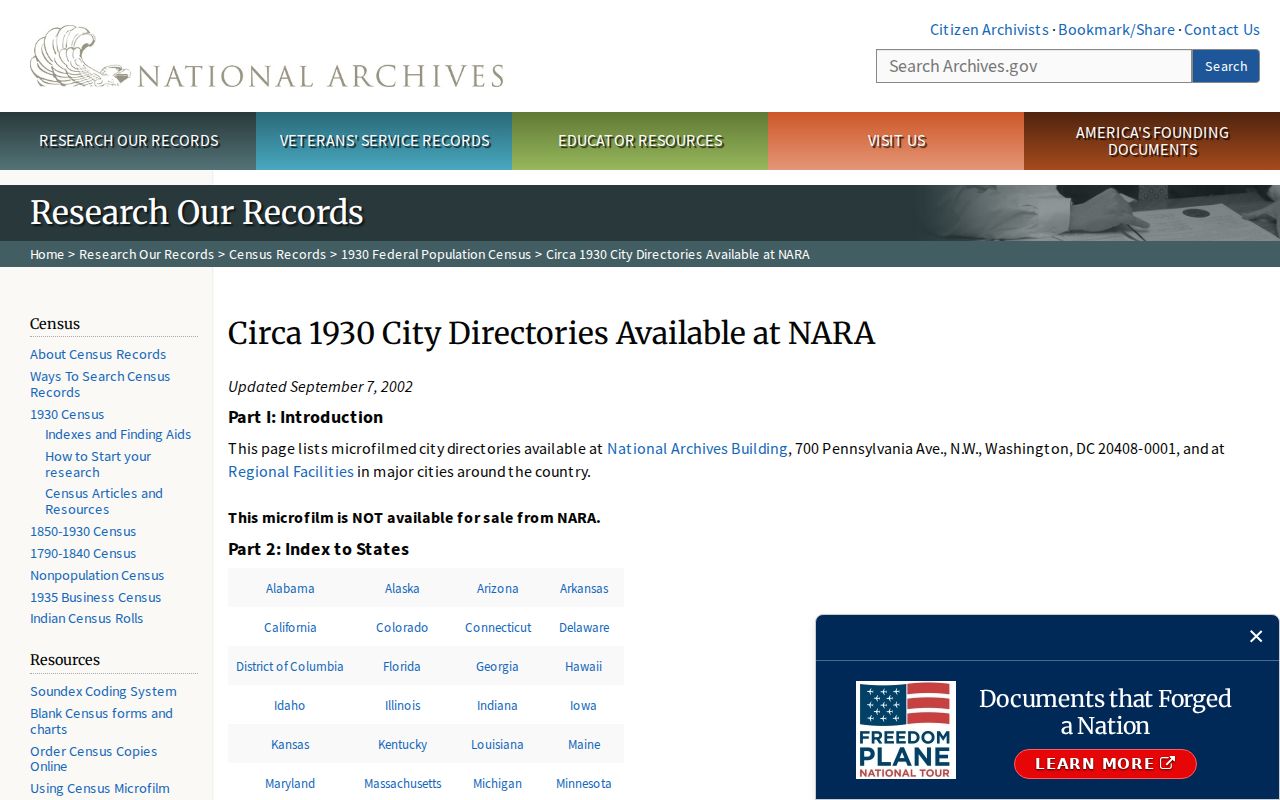
The NARA inventory image links to the official directory page. It ties the Merced city directory years to a named federal collection rather than an assumed online run.
Interest detail. The 13 verified annual editions make the Merced-Madera shelf unusually useful for comparing a household with the 1920 and 1930 census dates.
Merced Directory Shelves at the Museum
The Courthouse Museum supplies publisher and year information that the broad NARA inventory does not. Its archive lists Polk's California State Gazetteer for 1890, Polk's Merced City Directory in the 1914, 1928-1929, 1930-1931, 1935, 1938, 1941, 1963, and 1966 years, and Polk's Merced-Atwater Directory for 1971, 1972, 1980, 1988, and 1989. It also holds Merced County Business Directories for 1877 and 1884-1885. Other Polk Merced and Merced-Atwater years are attributed to the public library.
The archive is noncirculating. The collection page asks researchers to meet the archivist, sign in, use pencils and cotton gloves, and arrange access on Wednesdays from 10 a.m. to 2 p.m. or by appointment. Black-and-white photocopies have a suggested 10-cent donation; color copies and fragile material have different limits. The archive can be reached at (209) 723-2401 or info@mercedmuseum.org, while the research-room contact is also listed in the county's library and museum information.
The Courthouse Museum archive collection is the source shown below.
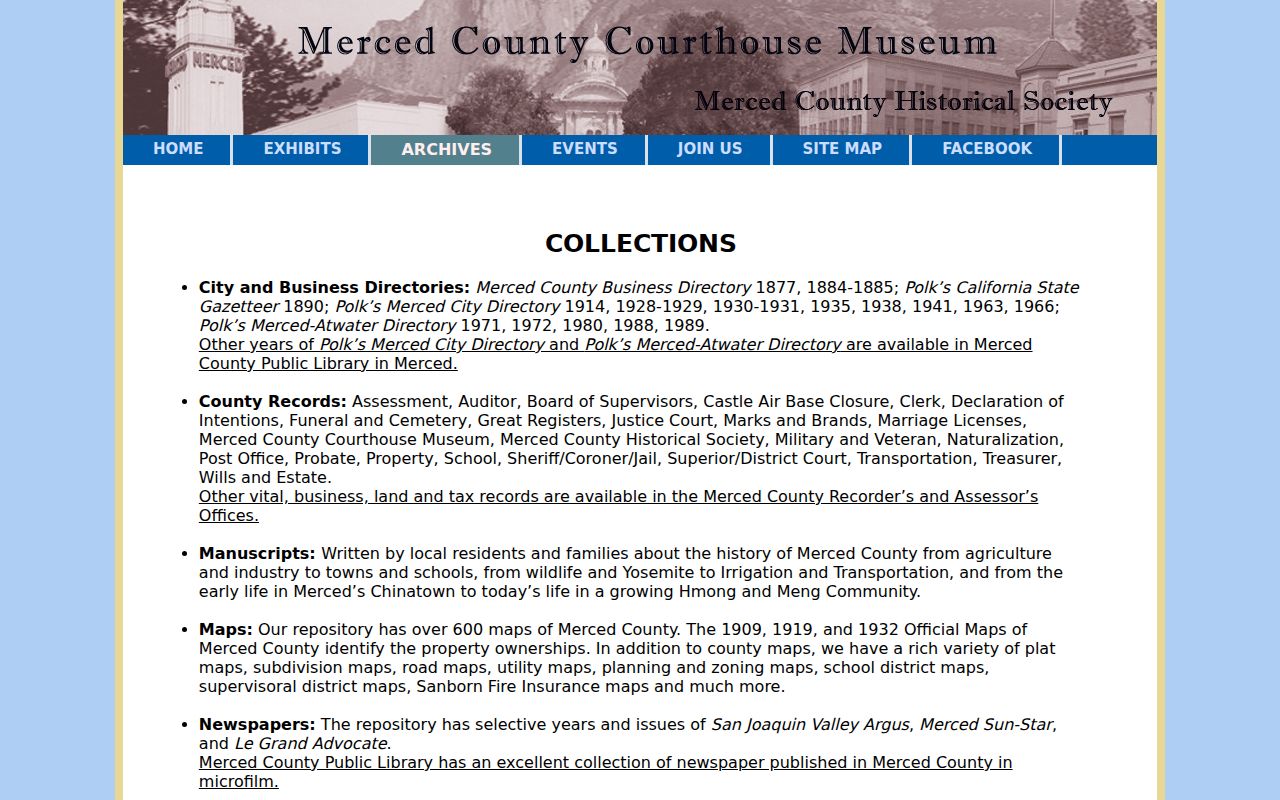
The museum collection image leads to the shelves. Directory volumes sit beside maps, photographs, property files, probate material, cemetery records, and other local series. Its 600-plus maps deserve special attention. Official county maps from 1909, 1919, and 1932 identify property owners by name. Those maps can bridge a directory address to a parcel. They can also explain why a street sequence looks nothing like today's map.
Merced Directory Research Rooms
The Merced Main Library at 2100 O Street serves as the local genealogy fallback. Its Genealogy Room is supported by the Merced County Genealogical Society. Its volunteers can orient a searcher to family files, directories, cemetery sources, and newspaper leads. The Stoddard Room is a separate local-history strength. A county historic-resources report describes its detailed material on Merced County sites and buildings. It calls that information not available elsewhere. Call (209) 385-7484 before planning a visit.
Cardholders with a PIN can use the library's NewsBank access. It includes the Merced Sun-Star from 2001 to the present. Obituaries, anniversary notes, civic announcements, school honors, and property stories often explain a disappearance. They show why a person vanishes from one Merced city directory year to the next. Older newspaper coverage requires a catalog or microfilm check. UC Merced's Regional Archives and Calisphere contribute photographs, documents, agricultural history, and community collections. These include the George Ballis Social Change Collection with more than 31,000 images.
The Merced County library and museum support page and its online databases index point researchers toward local collections. They also offer remote starting points.
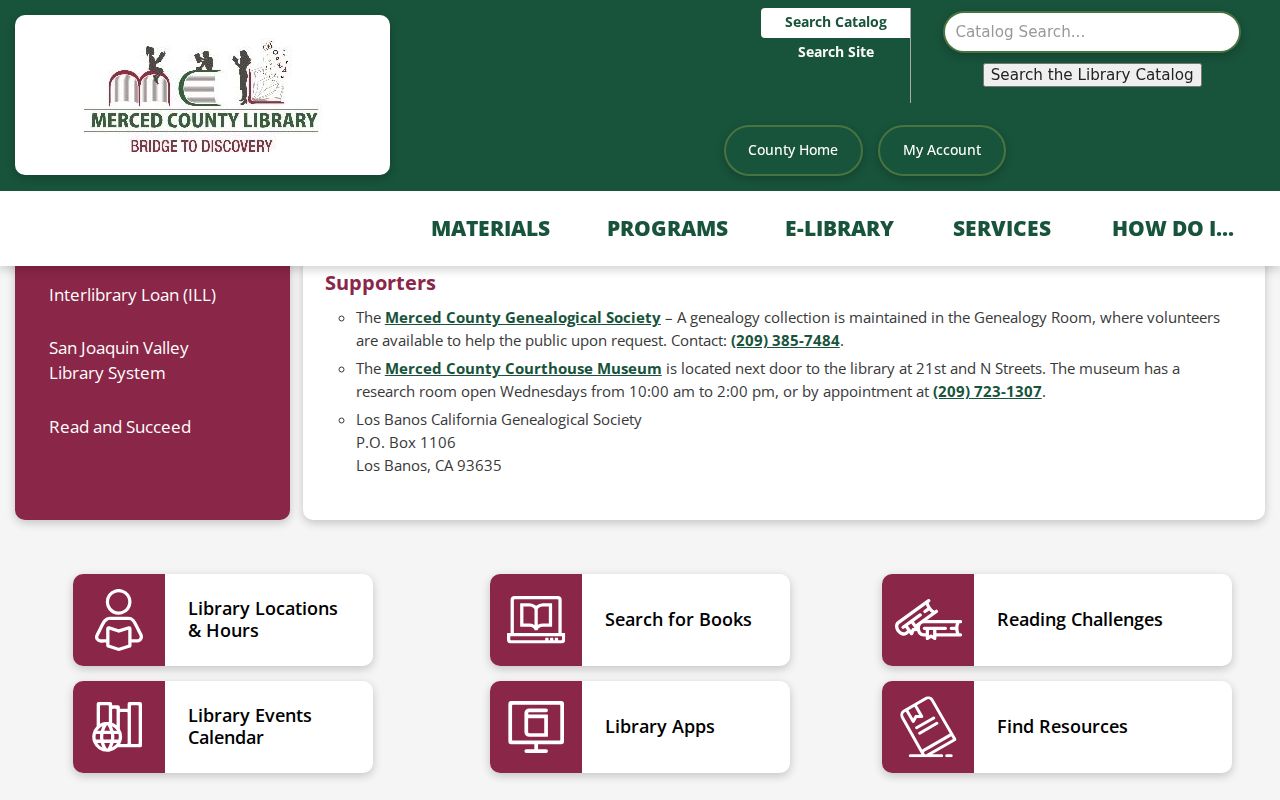
The linked county resource lays out the library and museum route for a Merced directory year that is not sitting in a convenient online database. Search State Library catalogs for “Merced” and for each city in the county, not just the county name. Telephone books can supplement a city directory, though their coverage and privacy practices differ. Treat every catalog hit as a lead. Verify the item-level year before writing it into a family timeline.
What a Merced Directory Entry Reveals
An era-typical entry in a Merced city directory packs identity, occupation, household relationships, and address into a single compact line. No viewable Merced page image from an authoritative open collection exists for a verified sample. The inventory below therefore describes common conventions and should be checked against the volume in hand.
| Entry element | What it may mean |
|---|---|
| Name | Surname, given name or initial, spouse in parentheses, widow notation, or a cross-reference. |
| Occupation and employer | A clue for identity and social history. It is not a complete biography. |
| Home address | House number and street, sometimes with a mark for residence or rooms. |
| Owner or occupant mark | A publisher convention that needs the volume's own key before interpretation. |
| Classified listing | A firm or trade entry, which may place a business rather than a household. |
| Street or criss-cross section | Address first, followed by an occupant, telephone, business, or related listing. |
- Criss-cross directory
- The reverse section of a directory, keyed by address rather than surname. It can show a past occupant at a known house.
- Householder index
- A name or address finding aid for a household head. It may exclude boarders, lodgers, or people outside the publisher's canvass.
- Abbreviation key
- The guide that explains short marks such as h for house, r for resides or rooms, and emp for an employer marker. Photograph this key first.
- Index versus image
- An index points to a page or record. An image shows the printed context and may expose a neighboring entry or an editorial mark.
Keep the entry's spelling exactly as printed. Do not quietly expand an abbreviation into a guess. A spouse in parentheses offers a family clue, and an occupation can separate two residents who share a name, though neither field alone establishes identity.
Reverse Merced Directory Pages
Start with the street or criss-cross section when the name is unknown. Copy the address exactly as printed. Write down the neighbors on both sides. Note every abbreviation as well. Then return to the alphabetical section and follow each likely surname from there. A street sequence can reveal a move, a changed number, or a business run from a home. It can also surface a household the tax roll missed. The occupant was not the owner.
Address matching needs restraint. Merced County mixes agricultural roads, rural routes, city grids, subdivisions, and communities. Some postal places differ from their city-limit jurisdiction. A directory address may be abbreviated or outdated. Confirm any candidate against a deed, map, newspaper, or census. Only then call it the same parcel or household. For a modern parcel, the current address chain belongs on the Merced by-street page. The collection page stays focused on reading and locating the historical volumes.
Trace Merced Directory Households
Follow the household, not just one entry. A Merced directory becomes far stronger when a researcher tracks a family across volumes instead of one isolated listing. Pair the publication year with a nearby census, deed, obituary, or newspaper event, and never treat a first appearance as the start of the family's entire stay. Treat a first listing as a clue only.
- Choose the closest Merced city directory to a known birth, marriage, move, death, or property event.
- Search surname variants, spouse names, initials, and the address section, then copy the complete entry.
- Move one directory year earlier or later and mark the address, occupation, spouse, and notation changes.
- Pair 1914, 1917, and 1920 material with the 1920 census, then use the 1926-1931 run around the 1930 census.
- Use the 1935 directory with the 1940 census residence question, then close the trail with newspapers, probate, or cemetery records.
Disappearance has many causes. A resident may have moved or died. They may have changed a surname, stopped subscribing, moved to a rural route, or been carried under another household member's listing. A deed can prove a transfer. Only a directory, census, or other occupancy source supports the household layer, and the newest public federal population schedules run through 1950, since the 72-year rule opens the next release in 2026.
Merced Directory and Census Timeline
This timeline keeps records distinct and shows their overlaps.
| Period | Research use |
|---|---|
| 1877 and 1884-1885 | Merced County business directories at the Courthouse Museum establish an early commercial and place-name layer. |
| 1890 | Polk's California State Gazetteer adds a statewide business and locality reference. |
| 1914-1922 | Merced-Madera directory years from NARA bracket the 1920 census and include several county communities. |
| 1926-1935 | The denser NARA run brackets the 1930 census and links to the 1940 question about 1935 residence. |
| 1938-1989 | Museum-listed Polk years extend the local shelf, with exact coverage varying by city and repository. |
| 2001-present | Merced Sun-Star NewsBank access supplies modern obituary and civic-history leads through the library. |
Dates are not interchangeable. A directory is an annual snapshot. A census counts on a set date, a deed records title, and a newspaper reports an event, so any difference between them is a prompt to investigate.
Where Merced City Directories Fall Short
Printed directories miss plenty of people. Rural residents, seasonal and migrant households, women listed under a spouse, boarders, and people with two surnames often go unrecorded. Some were simply never reached. OCR can misread names as well. A directory may also keep an old street name after a subdivision, annexation, or renumbering changed the modern address. Absence is never proof of departure.
For a current ownership question, move on to the Assessor, Tax Collector, GIS viewer, and Recorder. For a one-person identity question, pair the directory with dates, a spouse, occupation, deed, court, or vital records. For a former neighbor, the address-first section can suggest a lead, but lawful personal use and privacy limits still apply. The history reads richest with limits beside the facts.
Historical-use reminder. A Merced city directory is a research clue about a publication year. Confirm any important identity, relationship, or present status with the office or collection that holds the underlying record.