
Start a Merced Residents Directory Search
There is no single Merced residents directory maintained by one office. Merced County contains Atwater, Dos Palos, Gustine, Livingston, Los Banos, and Merced, along with unincorporated communities. That geography changes the first stop. A deed, tax bill, or recorded map normally leads to the county Assessor-Clerk-Recorder. A permit can sit in a city department or the county Accela system. An old household may appear only in a library room, museum file, census page, or newspaper.
Keep the purpose narrow. Ownership, occupancy, a public event, a family relationship, and a historical address are different questions. A property roll is not a household list. A business filing gives a business address, not a home. A directory omission does not prove that a person left Merced County. The best resident directory search records the source, date, exact spelling, and role shown by each result.
- Write down the known name, address, city or postal place, and an approximate date.
- Use the Tax Collector address search or county GIS to identify the parcel and jurisdiction.
- Check the RecorderWorks index, court system, or official state lookup that fits the question.
- Use the library, museum, directories, census, and newspapers for an older household or family trail.
- Ask the custodian for a copy or a public-records response when the online index ends.
That sequence keeps a convenient search from becoming a false identity match. It also sends street-level work to the Merced by-street directory; one-person work follows the same records with a narrower identity question.
The Merced County Records Desk
The Assessor-Clerk-Recorder at 2222 M Street in Merced is the strongest starting point for land, recorded documents, marriage records, and county-filed birth and death copies. The Recorder Division can be reached at (209) 385-7627. The Assessor phone is (209) 385-7631. Its official department page links the divisions and related services. RecorderWorks covers indexed official-record information from 1963 forward; pre-1963 indexes and free office viewing kiosks require an in-person visit.
Property research has an important split. The Merced County Assessment Inquiry accepts an Assessment Number or Fee Parcel Number, not an owner or street name. The separate Tax Collector property search supports documented street-address searching and can supply the parcel number needed for the assessor system. The county's online services list also points to parcel maps, assessment data, and related property tools.
Election records are held by California's Secretary of State and the county elections office, but a general public name search is not available. The court keeps civil, small claims, probate, family, criminal, juvenile, mental-health, and traffic files under its own access rules. The library, museum, and UC Merced archives fill the older gaps. Together these offices form a practical Merced residents directory map, even though each source has a different purpose.
Merced Superior Court
627 W. 21st Street
Merced, CA
(209) 725-4100
Court case records portal
Merced Main Library
2100 O Street
Merced, CA
(209) 385-7484
Genealogy Room support
Recorder, court, and library access do not merge into one database. Ask for the record series by name, give a date range, and preserve the office's wording for the result.
Merced Property Records: Two Doors
The local property path corrects a common assumption: the public assessor interface is not an owner-and-address people search. Begin with the Tax Collector's documented Street Address mode when the only clue is a situs address. Read the returned assessment number or fee parcel number, then carry that key to Assessment Inquiry. The parcel number joins the assessment, map, tax, deed, and permit trails more reliably than a person name.
| Portal control | What the Merced interface does |
|---|---|
| Search By | Tax search can use a documented street-address mode; Assessment Inquiry uses Assessment or Fee Parcel. |
| Search Term | Use the address format accepted by the tax portal. It advises shortening Street, Road, Drive, or Lane and using N, E, S, or W. |
| Roll Year | Select a current or prior roll year where offered; older tax data is historical, not proof of present occupancy. |
| Parcel result | The tax-bill block can show assessment number, fee parcel, physical-address location, lien-date owner, tax-rate area, and a separate mailing block. |
| Assessment Inquiry | Enter the parcel or assessment key for values, exemptions, characteristics, assessment maps, and related parcel information. |
Keep situs and mailing in separate notes. Situs identifies the land. Mailing tells where tax correspondence goes. A different mailing address can reflect a trust, agent, post-office box, or absentee owner. It does not identify other occupants or prove that the owner sleeps at the parcel. For a street-by-street parcel chain, use the Merced tax search and then the address workflow on the by-street page.
- Parcel
- A county tax unit identified by an APN or fee parcel number. A split or merger can change the key.
- Situs address
- The physical location assigned to the land, distinct from the address used for tax mail.
- Legal description
- The title description, such as a subdivision lot or township and range reference, that can outlast street wording.
- Index
- A finding aid with names, dates, and document details. It is not the same as the recorded image.
Note: A parcel result is a location and ownership clue, not a complete Merced resident directory entry.
Merced Voter Records Are Personal
California My Voter Status is often mistaken for a public voter directory. It is not. The authenticated state form asks for first name, last name, full birth date, and a California driver license or identification number, or the last four numbers of a Social Security number. It returns the authenticated voter's registration status, polling information, party preference, language preference, district information, and vote-by-mail or provisional-ballot status.
California Elections Code sections 2180 through 2194 restrict voter-file disclosure to approved political, electoral, scholarly, journalistic, or governmental purposes. Commercial use is prohibited. Residence, mailing address, status, registration date, precinct, district data, and participation history are handled differently from a casual Merced residents directory. Participation shows whether a ballot was cast, not how anyone voted. Signatures, full birth dates, identity numbers, and ballot choices are not an open browseable roll.
| My Voter Status field | Why it matters |
|---|---|
| First and last name | Matches the person's own authenticated registration record. |
| Date of birth | Separates the record from people with similar names. |
| DL or ID / last four SSN | Provides the identity check; the form lets a user state that a number is unavailable. |
| Submit or Clear | Runs or resets the self-service form. Recent registration changes may need time to appear. |
Safe at Home participants use confidential voter registration through the Secretary of State rather than ordinary online registration. That shield is one reason a missing name cannot be treated as evidence that a person is absent from Merced County.
Today’s Merced Resident Sources
A current Merced residents directory is really a set of partial rolls. Each row below describes a different relationship to a place. Use the source that matches the question, then confirm with the custodian when an entry matters.
| Source | What it can show | Keeper | Access |
|---|---|---|---|
| Assessment and tax roll | Owner of record, situs, tax mailing, APN, values, and characteristics | Merced Assessor / Tax Collector | Portal, office, parcel inspection |
| Recorded-document index | Grantors, grantees, deeds, liens, maps, dates, and document numbers | Recorder Division | RecorderWorks from 1963; counter before that |
| Permit and planning files | Project address, applicant, parcel, status, inspections, and work description | County Accela or city department | Limited anonymous portal access or request |
| Court records | Public party names, roles, events, and dispositions where access permits | Merced Superior Court | Remote civil subset, terminal, counter, or mail |
| Library and archive collections | Directories, newspapers, photographs, local files, and historical households | Library, museum, UC Merced, NARA | Online or in person by collection |
Business filings, professional licenses, and unclaimed property can add an affiliation clue, but a principal address, license address, or old claim is not a present residence. The safer method is to preserve the exact label and date. A person listed as an agent, licensee, party, owner, or occupant has not been shown to hold every other role.
Merced Court Records Have an Offline Edge
The Merced Superior Court Public Portal requires registration and remotely exposes nonconfidential documents only for limited civil, unlimited civil, and small claims cases. Its search controls include case number, party or business name, split first, middle, and last name fields, filing-date ranges, and case type. A typical civil result may show the case number, caption, filing date, status, party roles, register-of-actions events, hearings, disposition, and links for purchased documents. Tyler Technologies charges at least one dollar per document transaction.
Criminal, family, juvenile, adoption, paternity, probate, mental-health, and traffic material is not a complete web result set. The court's records-search instructions describe public terminals, clerk searches, copies, certification, off-site retrieval, and mail requests. The courthouse public computer at 2260 N Street is an insider tip for criminal lookup that the public portal cannot replace. The clerk counter is at the Charles James Ogletree Jr. Courthouse, with filing hours Monday through Friday from 8 a.m. to 3 p.m.
Search distinction. A court index tells you that a filing or event exists. It does not, by itself, establish the truth of an allegation, a current address, or a person's present status.
For a longer search, local instructions list a $15 charge after ten minutes, 50 cents per copy page, $40 certification, and a $15 off-site retrieval charge. Form MSC-RR-001 asks for a case number if known, party names and aliases, approximate filing dates, case category, documents, copies, certification, and a maximum charge. These counter and mail channels make the Merced court record trail usable when the online resident directory route stops.
Note: Federal cases use PACER and the Eastern District of California, not the Merced state-court portal.
Merced Vital Records Use Copy Rules
California vital records turn on the type of copy requested. Health and Safety Code sections 103525 and 103526 limit authorized certified copies to listed relatives, registrants, representatives, court-authorized requesters, and other statutory categories. An ineligible requester can generally seek a certified informational birth, death, or public-marriage copy marked not valid to establish identity. Confidential marriage certificates are different and come from the issuing county clerk only to a party or a person acting under court order.
The Merced County Recorder issues county-filed birth and death records and public marriage copies. The local registrar at Public Health handles current and prior-year births and deaths. CDPH-Vital Records is the statewide source for births, deaths, fetal deaths, marriages, and divorce records. The county fee schedule lists 2026 fees of $31 for birth, $26 for death, and $19 for marriage. The marriage application asks for both parties, a date or approximate year, the license county, the applicant's relationship, copy type, signature, and payment. A search fee can be retained when no record is found.
For family history, an index, obituary, cemetery register, church record, or newspaper can identify an event without opening a restricted original. Adoption originals and confidential medical or social birth data remain protected. Use California's official adoption-information or mutual-consent path instead of trying to bypass a closed file. These boundaries keep a Merced residents directory from overstating what a name search proves.
The Merced Superior Court case-records portal is the source shown below.
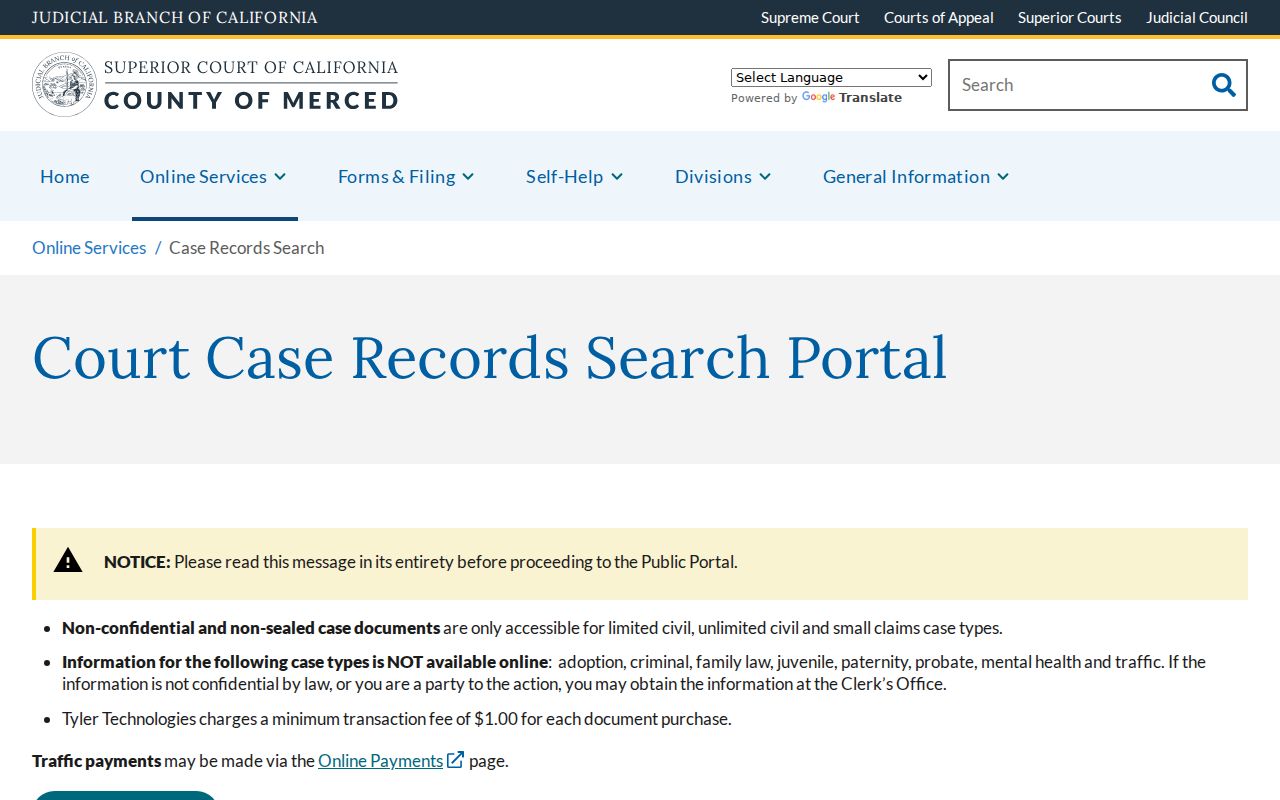
The Merced Superior Court portal image is available from the official case-records search page. It illustrates the narrow online court route that complements, rather than replaces, the county clerk and records counter.
Merced Library Resident Trail
Modern search tools leave large historical gaps. The Merced Main Library at 2100 O Street houses the Genealogy Room, where Merced County Genealogical Society volunteers help with family files, local directories, cemetery materials, and newspaper leads. The Stoddard Room is especially valuable for detailed county sites and buildings; a county historic-resources report describes material there that is not available elsewhere. The adjacent Courthouse Museum research room at 21st and N Streets is open Wednesdays from 10 a.m. to 2 p.m. or by appointment, and its archivist can orient a researcher to maps, photographs, vertical files, and record series.
The library's NewsBank access includes the Merced Sun-Star from 2001 to the present for cardholders with a PIN. Obituaries, civic notices, school honors, anniversaries, and property stories can explain a gap between a deed and a directory entry. Older coverage needs a catalog, microfilm, museum, or State Library search. UC Merced's Regional Archives and Calisphere add a digitized Merced Local History Collection and Central Valley collections, including George Ballis photographs of agricultural communities and labor history.
The NARA directory inventory verifies Merced-Madera volumes for 1914, 1917, 1920, 1922, 1926 through 1931, and 1935. The full historical shelf deserves its own Merced city directory collections treatment because a directory is an annual snapshot, not a current residents directory.
That local-history route shows why an in-person library or museum visit can add context that a name index cannot supply.
Merced Resident Business Clues
Some name trails begin with a public role rather than a home address. California Secretary of State bizfile searches entities by name or number and can show status, registration date, entity type, jurisdiction, principal or mailing address, agent for service, and filing history. A county fictitious business name filing can connect a trade name to a registrant. The Department of Consumer Affairs license search accepts a board or license type, license number, person or business name, and location refiners, then may show status, issue and expiration dates, address of record, discipline, and public documents.
These systems are useful for verifying a business owner, professional credential, or public-facing affiliation. They are not resident rolls. An agent's address may belong to a law office, a principal's mailing address may be a business site, and a license address may be a regulated premises. The exact role label and date matter more than a familiar name.
- Entity or trade name
- Official source: California bizfile or Merced FBN. Typical result: Entity number, status, filing history, registrant or agent. Limit: A business connection, not a home residence.
- Professional identity
- Official source: California DCA search. Typical result: License type, number, status, dates, and public discipline. Limit: The address of record can be professional.
- Old name or address
- Official source: State Controller unclaimed property. Typical result: Reported owner name, city, property type, and property ID. Limit: A past-claim lead that requires proof.
The California DCA license search supplies the public fields shown in the next image.
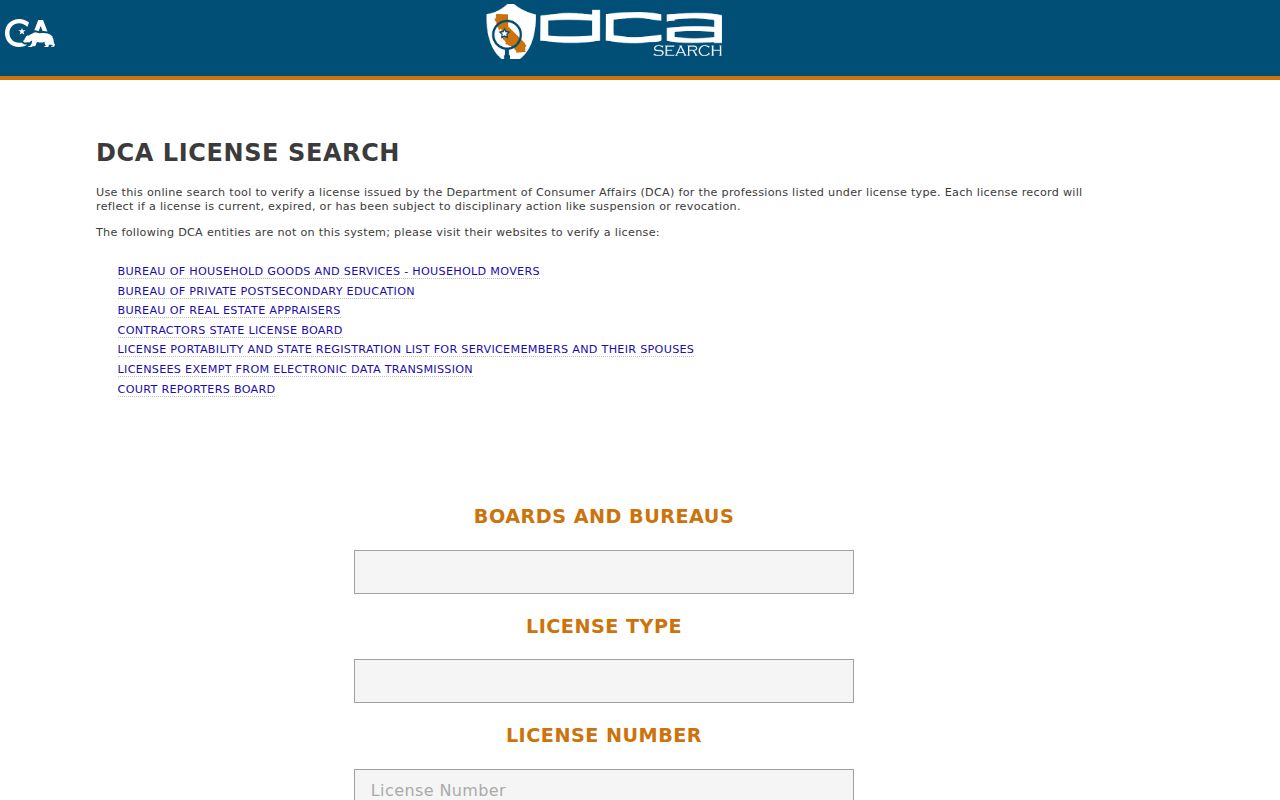
The linked DCA search image shows the public license fields used for an affiliation check, not a private-household lookup.
The California bizfile business search is the source for the entity fields shown here.
The state business search is another official source for separating an entity address from a person's residence.
Older Merced Residents Directory Shelves
Printed Merced city directories preserve names, occupations, spouses, addresses, and sometimes owner or occupant marks, but their coverage depends on a canvass or subscription. The Courthouse Museum lists Merced County Business Directories for 1877 and 1884 to 1885, Polk's California State Gazetteer for 1890, and Polk's Merced City Directory volumes for 1914, 1928 to 1929, 1930 to 1931, 1935, 1938, 1941, 1963, and 1966. It also lists Polk's Merced-Atwater Directory for 1971, 1972, 1980, 1988, and 1989. Other years are attributed to the public library.
The NARA run adds 1917, 1920, 1922, and 1926 to 1927, and its listing includes Atwater, Livingston, and Chowchilla. A typical alphabetical entry may show a surname, given name or initial, spouse in parentheses, occupation, employer, home address, and abbreviations such as h, r, or emp. A street or criss-cross section reverses the order to address first. Treat those fields as directory conventions until a Merced volume is inspected, because no authoritative open page image was located for a verified local entry.
The best historical sequence pairs a directory with the nearest census: the 1914, 1917, and 1920 volumes around the 1920 census; 1926 to 1931 around the 1930 census; and the 1935 volume with the 1940 question about a person's 1935 residence. Deeds separate ownership from occupancy. Newspapers, probate, and obituaries explain why a name appears, moves, or disappears.
- Criss-cross directory
- An address-first section that reverses the alphabetical name list and can expose occupants around one street.
- Householder index
- A finding aid keyed to the head of a household or address, subject to the publisher's rules.
- Abbreviation key
- The volume's guide to short marks for residence, rooms, occupation, spouse, or business. Photograph it first during a visit.
- Directory snapshot
- A publication-year view shaped by canvass, subscription, rural coverage, and listing conventions.
Merced Resident Names Need Proof
Same-name errors grow when a county has several cities, rural routes, seasonal movement, and names indexed in different ways. Preserve middle initials, suffixes, two-surname order, hyphenation, maiden and married names, and the source's exact party role. Search surname components separately when the index permits. A Spanish compound surname or an OCR mistake can split one person into two records; an initial can also join unrelated people.
Use at least two independent anchors. An APN and legal description can support a deed match. A license number or entity number can support a business identity. A spouse, occupation, date, or newspaper event can help explain a directory entry. A 1990 address cannot establish a 2026 residence, and a mailing address cannot prove occupancy. The careful Merced residents directory method keeps a result as a lead until the custodian confirms it.
Comparison. Official rolls identify the relationship they were created to record, such as owner, party, licensee, or registered voter. Commercial people-finder data may combine stale public snippets and undisclosed sources. Use it neither to override an official contradiction nor to treat an address lead as proof.
For family history, the strongest pairing may be a directory and census. For an heir, use probate, estate deeds, and an obituary. For a former classmate, use yearbooks, school archives, local newspapers, and the library. For a public business connection, use the Secretary of State and DCA. Each path keeps the human purpose clear without turning a partial record into a claim about a living person.
Note: A missing entry may reflect rural coverage, language, mobility, subscription limits, or a protected address rather than a missing resident.
Merced Public Records Request Fallback
When a named Merced County record is not in an online portal, the California Public Records Act remains a route to an identifiable record. Government Code sections 7920.000 through 7931.000 recodified the former section 6250 series in 2023. A request should name the department, record type, address or project number, and date range. A purpose statement is ordinarily not required. The agency must determine within 10 calendar days whether the request seeks disclosable records and may take a written extension of up to 14 days for unusual circumstances.
The ten-day rule is a determination deadline, not a promise that production occurs in ten days. Agencies may segregate exempt material, redact protected fields, and disclose the rest. Direct duplication costs or a statute-specific fee may apply. Court case records follow court access rules rather than ordinary CPRA, while judicial administrative records use California Rules of Court 10.500. That distinction prevents a general request from being sent to the wrong desk.
- Identify the Merced County or city department that created the record.
- Describe the address, parcel, project number, person, record series, and date range.
- Ask for electronic inspection first and state that nonexempt portions may be segregated.
- Save the request, determination, redactions, fee quote, and the custodian's contact.
The county Accela portal is a useful first check for unincorporated building, planning, enforcement, license, and public-works material. City clerk requests cover municipal minutes, ordinances, contracts, boards, commissions, and other administrative records, subject to exemptions. Neither system is a complete Merced residents directory, but each can connect a name or parcel to a public interaction.
Where Merced Resident Records Stop
California's Safe at Home program gives eligible survivors, victims, and certain workers a substitute mailing address and supports confidential voter registration. DMV information is restricted by the federal Driver's Privacy Protection Act and California vehicle rules. Adoption records, juvenile matters, sealed cases, confidential marriage records, protected mental-health material, and sensitive identifiers have their own limits. Public does not mean every field is searchable by every person.
The California Consumer Privacy Act and California Privacy Rights Act give qualifying consumers rights to know, delete, correct, limit certain sensitive-data uses, and opt out of sale or sharing, subject to exemptions. Government-record information may be exempt. A deletion request to a data broker therefore does not erase a deed or assessment roll. In February 2026, the Attorney General described the free DROP platform as a way to send one deletion or non-sale request to more than 500 registered data brokers.
Lawful personal use. Merced public records support family history, civic research, property curiosity, and legitimate personal verification. Never use a record to stalk, harass, intimidate, or harm a person, and stop when a custodian identifies a protected boundary.
The California State Controller unclaimed-property search is the source shown below.
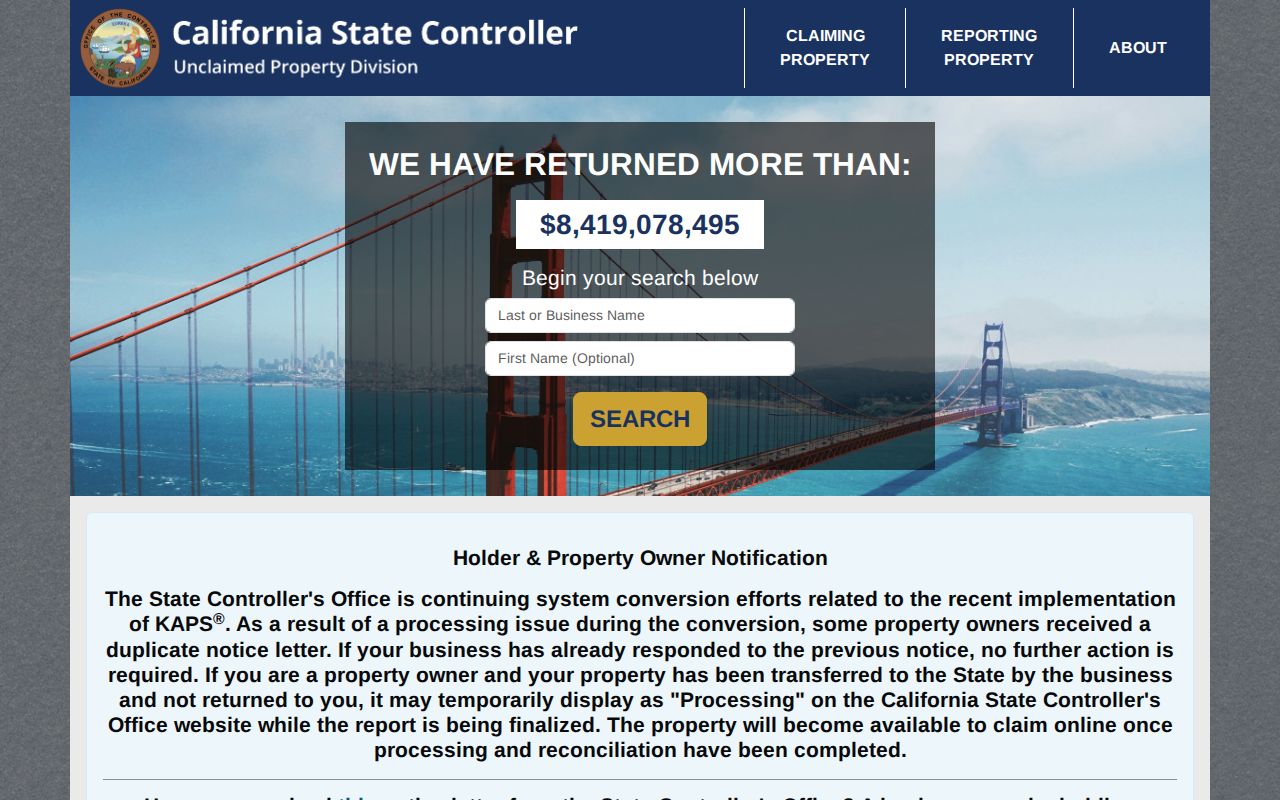
The official unclaimed-property search is a past-name lead that still requires identity and relationship documentation. It is not evidence of a current Merced address.
Merced Residents: 2026 Fees and Tools
Recent changes affect both access and privacy. California vital-record fees increased on January 1, 2026, and the Merced schedule lists $31 birth, $26 death, and $19 marriage searches or copies. The court portal may charge at least one dollar for a Tyler document transaction, while a clerk search, copy, certification, or off-site retrieval follows its own schedule. A RecorderWorks index is free for 1963-present metadata, office kiosks permit free viewing, and ordered copies cost money.
Privacy advice also changed in 2026. The Attorney General's February 18 announcement about DROP gives Californians a statewide deletion route for registered data brokers, with compliance beginning August 1, 2026. Use the official Attorney General notice and preserve confirmation. A private deletion request cannot change the county's official land, court, or vital record. It can reduce duplicate broker listings that are often less reliable than the underlying custodian.
Merced County's combined records desk was formed in stages: the Recorder merged with the Assessor in January 2009 and with the Clerk in February 2012. That history explains why current service pages bring several record families together, while older indexes remain in separate books, microfilm, counters, library shelves, and archives. The most useful residents directory is therefore a route map with clear limits, not a claim of completeness.